 Swaap
Swaap AMM research models USDC/USDT and wstETH/WETH exchange rates
Swaap AMM research compares USDC/USDT and wstETH/WETH by modeling the price relationship within each asset pair. The stablecoin case concerns two tokens with a shared dollar target. The staking case pairs a value-accruing staking token with wrapped ETH, so the analysis adjusts for staking yield. Both cases use nested mean reversion to investigate liquidity quotes under defined modeling assumptions.
Updated onJump to a section
The November 12, 2024 study, Automated Market Making: the case of Pegged Assets, develops these cases through calibration, filtering, and numerical simulations. Its comparison concerns how quotation models handle related assets and their different price dynamics.
Relative Prices and Quotation Inputs
The relationship between the tokens determines which price movements an automated market maker needs to explain. An AMM supplies liquidity by quoting prices for exchanges between assets. USDC/USDT expresses the value of USDC in USDT; wstETH/WETH expresses the value of wstETH in WETH. Each ratio describes a different market, even though both involve economically related tokens.
A dollar-price chart alone does not show either relative exchange rate. The relevant ratio incorporates the prices of both assets.
USDC/USDT and the Dollar Anchor
USDC and USDT target the same fiat currency, giving their exchange rate a shared economic anchor. Their market prices can still diverge. A quotation model must account for movements between the tokens even when both retain their dollar target. The duration of a divergence matters alongside its size. The model can represent prolonged deviations while still assuming eventual reversion toward a long-term mean. A lasting break in the relationship can invalidate that assumption.
wstETH/WETH and Staking-Yield Drift
Staking accrual changes wstETH/WETH because wstETH wraps stETH in a non-rebasing, value-accruing token. Its balance stays unchanged through an oracle rebase, while its stETH value changes. WETH represents ETH in ERC-20 form, making the pair a staking-asset comparison in ETH terms. The economic relationship therefore includes an accrual component that the stablecoin comparison does not share.
The Yield Adjustment
The wstETH/WETH analysis discounts staking-yield drift before fitting its mean-reverting model. This treatment separates the estimated staking-yield trend from fluctuations around the adjusted reference.
Changing Yield
The framework allows a time series of staking yields for discounting. Using that approach in quote optimization also requires addressing future yield estimates.
Short-Interval Approximation
The paper also allows an approximately constant yield over short time scales, estimated from recent log-price drift. That assumption applies over the chosen interval.
Nested Mean Reversion and Filtering
Nested mean reversion allows the exchange rate to move toward a target that can itself change. An Ornstein-Uhlenbeck process describes movement toward a mean; the nested construction gives that target its own dynamics. This accommodates deviations that persist longer than a fixed-target model may capture. The changing target also reverts toward a fixed long-term mean.
Calibration estimates model parameters from price observations. Filtering estimates the unobservable target, supplying information that the quotation model can use.
Price and Demand Modeling Options
Price dynamics and trading demand describe different inputs to market making, so their models address different questions. The pegged-asset study centers on nested mean reversion. Related price-aware AMM research examines changing volatility, price jumps, and variable demand. Some of these choices can operate together within a quotation model.
| Modeling Option | Behavior Represented | Research Application |
|---|---|---|
| Standard Ornstein-Uhlenbeck | Reversion toward a fixed mean | Simplified baseline for pegged-asset dynamics |
| Nested Ornstein-Uhlenbeck | Reversion toward a changing target | USDC/USDT and yield-adjusted wstETH/WETH |
| Geometric Brownian motion | Price diffusion without a mean-reverting anchor | Comparison strategy for both studied pairs |
| Stochastic volatility models | Changes in price variance | Broader price-aware AMM price models |
| Jump models | Abrupt price changes | Broader price-aware AMM price models |
| Hawkes processes | Event-dependent activity | Microstructural prices and liquidity-taking demand |
| Markov-modulated Poisson processes | Demand across switching states | Variable liquidity-taking demand |
What Did the Pair Comparison Demonstrate?
The historical simulations found a larger disadvantage for the Brownian-price benchmark in wstETH/WETH than in USDC/USDT. The fitted, yield-adjusted wstETH/WETH series showed faster mean reversion than the USDC/USDT series in the studied sample. Under the assumed liquidity parameters, geometric Brownian motion could approximate USDC/USDT prices over short inventory round trips. For wstETH/WETH, fast mean reversion made that approximation unsuitable even over inventory round trips.
The study combines historical prices with simulated trading activity. Its performance comparisons describe that experimental setup, including the assumed trade flow.
Liquidity-Provider Returns Against Holding
The holding benchmark compares liquidity provision with keeping the starting assets outside the AMM over the same interval.
Trading revenue alone does not describe that difference. Exchanges change the assets that the pool holds, and subsequent relative-price movements affect their value. A strategy can collect markups while its changing inventory affects the comparison with holding. The earlier mean-variance research considers both expected performance and the variability of liquidity-provider outcomes.
The benchmark supplies a common basis for comparing models. It does not turn a simulation result into a fixed income rate.
Model Assumptions and Market Stress
A stablecoin depeg can outlast the reversion pattern that a model estimated from an earlier sample. Changing staking yield can alter the adjustment applied to wstETH/WETH. Each issue affects a different input to the quotation framework. The economic link between assets also leaves room for inventory losses. The study omits reserve-depletion risk, an approximation the authors justify for sufficiently large pools or when risk aversion is not too low. Swaap v2's onchain safeguards constrain trade execution under configured rules, adding a separate layer to statistical quotation.
Research Findings and Trading Availability
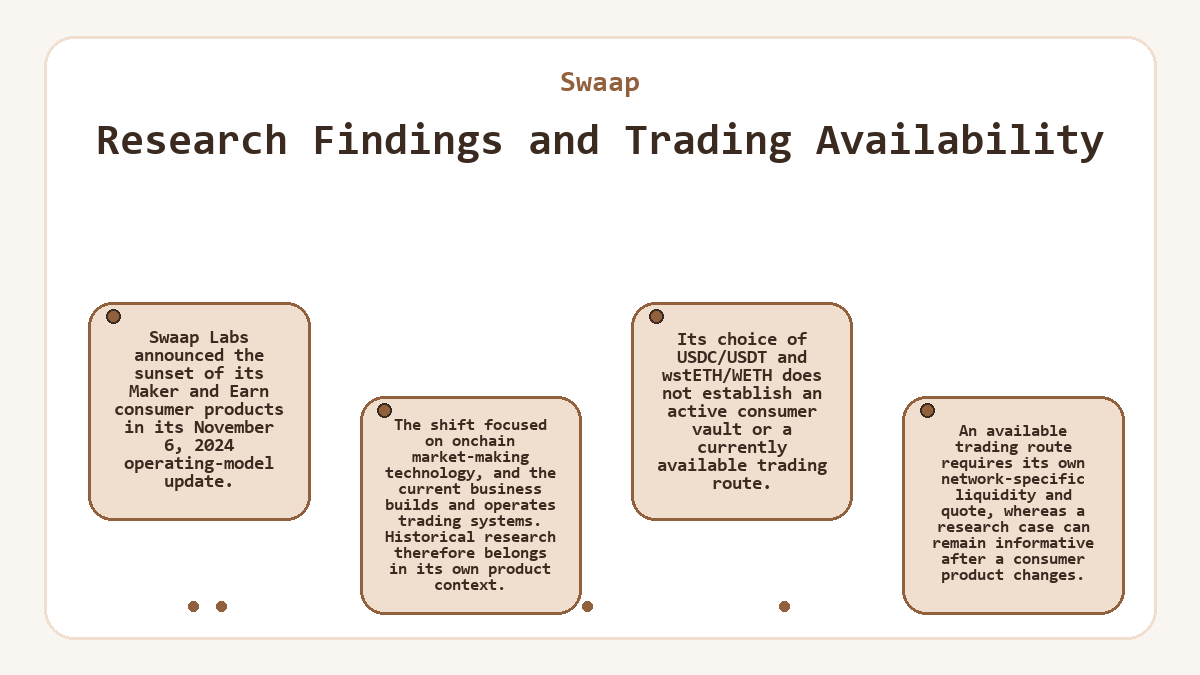
Swaap Labs announced the sunset of its Maker and Earn consumer products in its November 6, 2024 operating-model update. The shift focused on onchain market-making technology, and the current business builds and operates trading systems. Historical research therefore belongs in its own product context. Its choice of USDC/USDT and wstETH/WETH does not establish an active consumer vault or a currently available trading route.
An available trading route requires its own network-specific liquidity and quote, whereas a research case can remain informative after a consumer product changes.
Swaap - your questions answered
Which Historical Prices Underlie the USDC/USDT and wstETH/WETH Analysis?
The study uses dollar-denominated price observations from January 1 through March 31, 2024. It constructs USDC/USDT and wstETH/WETH relative rates from the corresponding token-price series.
Does Unwrapping wstETH Return WETH?
Unwrapping wstETH through its wrapper returns stETH, not WETH. WETH is a separate wrapped representation of ETH. The research compares the market relationship between wstETH and WETH; it does not describe the wstETH wrapper as a direct redemption route into WETH.
Is the model's Reference Price Directly Tradable?
The reference exchange rate in the pegged-asset model is indicative and is not directly tradable. It anchors the calculation of buying and selling quotes, whose prices can differ from that reference.
Can a Positive Result Against HODL Coexist With a Loss in Dollars?
A positive result against HODL can coexist with a loss in dollars. HODL measures the alternative of holding the same starting assets over the same interval. If those holdings lose dollar value, outperforming them alone does not establish a positive absolute return.
Are Research Markups the Same as SafeguardPool Management Fees?
Research markups describe the difference between reference prices and the AMM's buying or selling prices. SafeguardPool management fees operate through newly minted pool tokens that dilute existing ownership shares. These mechanisms have different calculation bases, so a model markup cannot be read as the management fee that a deployed pool charges.
Will Holding WETH Alone Earn the Staking Yield Modeled for wstETH?
Wrapping ETH into Ethereum's canonical WETH contract does not stake it. That contract represents deposited ETH with an equal quantity of WETH. The staking-accrual component in the pair comparison belongs to the wstETH side, whose token accounting differs from the ETH wrapper.